Tuesday, April 20, 2010

Exciting Day

Today I finally got the teach the first case study I've written:
  
Volkswagen AG: Valuation in 2009

This is a case on multiples valuation based on Volkswagen around on May 2009, right at the peak of the crisis.

I think the session went well and students enjoyed themselves. Hope I'm right!

Tuesday, April 13, 2010

Stock Analysts are Still Optimistic

The picture below comes from a McKinsey report (you need to register to read it all) showing that stock analyst tend to be overoptimistic.

Two things draw my attention:
i) In 2008, because of the crisis, the difference between January forecasts and the realized EPS is huge (almost 40%).

ii) The over-optimism in itself is not that surprising given the skewed incentives analyst have. Not even with regulatory changes seemed to have reduced the problem.

Saturday, April 3, 2010

Complexity

Today I followed this link from Brad Delong's and read a very nice story on how quickly the Internet would change the business model of TVs. Here is the into:

"I gave a talk last year to a group of TV executives gathered for an annual conference. From the Q&A after, it was clear that for them, the question wasn’t whether the internet was going to alter their business, but about the mode and tempo of that alteration. Against that background, though, they were worried about a much more practical matter: When, they asked, would online video generate enough money to cover their current costs?
That kind of question comes up a lot. It’s a tough one to answer, not just because the answer is unlikely to make anybody happy, but because the premise is more important than the question itself.
There are two essential bits of background here. The first is that most TV is made by for-profit companies, and there are two ways to generate a profit: raise revenues above expenses, or cut expenses below revenues. The other is that, for many media business, that second option is unreachable.
Here’s why...."
 The article then goes on and talks about how too much complexity can destroy societies. This reminded me of Collapse by Jared Diamond, which I highly recommend, on what made several different societies collapse over our history.

More important that how TV will be affected by the Internet, is how Western developed countries (Europe, the US, and Canada) will manage their complexity and the emergence of China.

Tuesday, March 30, 2010

Profits

I still think that the US Treasury might make a profit on assets it bought during the crisis:

Friday, March 19, 2010

Martin Wolf @ IESE

Today we had Martin Wolf giving a special lecture at IESE on  "Development and Globalization after the Crisis". His daily column on the Financial Times is very good and interesting, I recommend it to everyone. It was nice to meet him in person, but it is a shame that I don't have the slides of his presentation to show. It was also very good.

In summary, he is still very worried with the recovery of developed economies in the future. The fiscal outlook looks bleak for US/Europe and that the recovery can only be sustained if the private sector can replace public spending.

Saturday, March 6, 2010

Hedging World Cup Risk

Today I was walking around Barcelona and saw this interesting time-deposit offer from Banesto (a local bank). They promise you 3%/year, but IF Spain wins the World Cup, the investor gets 4%.


Around the World Cup we see all kinds of offers like this (in Spain, the UK, and Brazil at least): buy a flat-screen TV and if Brazil wins you get another one, etc.

An interesting question is how much money does the bank expects to spend with this offer? How should  this be hedged?  Of course, based on historical probabilities they won't lose a dime, but with Spain being one the favourites, what to do to at least find an estimate? 

Supose that the bank's reinvestment rate is 4%. If Spain does not win the World Cup, they make a 1% profit. If Spain does win, they make zero. The expected return is the 1%*(Prob Win), which looks good on their side given previous history.

I wonder if they could hedge this against a portfolio of online bets held by betting houses. 

Any ideas? This might turn into a nice exam question or topic for the derivatives course.

Thursday, February 25, 2010

Incredible Mistake

This story is in Spanish, but it is so good that I had to post the video here. Basically, the Romenian army wanted to help the humanitarian effort in Haiti by sending a battalion of mountain troops and 2,000 tons of supplies. However... their defense ministry messed up the names and sent everyone and everything to Tahiti instead!

I guess this is the kind of mess that we only expect to see in financial markets!

UPDATE: Just found out it was a hoax. I guess I should have done my due diligence better! :) Nice one though.

UPDATE2:  The story did appear in Spanish news, but THEY didn't do their due diligence. The story was in fact a hoax from a Romanian website. Nothing like blaming others... ;)

Wednesday, February 10, 2010

Spanish Mess

Paul Krugman has written a nice summary of how Spain has reached its current (poor) economic situation.

http://krugman.blogs.nytimes.com/2010/02/09/anatomy-of-a-euromess/

The comparison with Germany is also nice. We can definitely see all the rent income earned by Germans who invested in Spanish real estate. I bet that if we look at the UK we might see the same thing.

I wonder what will happen with the deficit as this rental income (due to smaller demand for real estate) goes down.

Thursday, February 4, 2010

Financial Bets

This is funny: the directors of the Indianapolis Museum of Art waged an online bet with the New Orleans Museum of Art which depends on who wins the Super Bowl this Sunday (the Indiana Colts play the New Orleans Saints). The losing city will lend a good paiting to the winning one for three months (Indianapolis waged a Turner, while New Orleans waged a Claude Lorrain).

Here is a quick suggestion for how to solve the problem with the Chinese yuan overvaluation: if the US has more medals than China during the next Summer Olympic Games, the Chinese agree to revalue their currency by say 20%. If they lose, the US government refrains from calling for a revaluation for at least 20 years...

Monday, February 1, 2010

Something to Relax the Eyes

Possibly my favorite painting:


I really should have gone to the d'Orsay last time in Paris. I'll pay the National Gallery a visit next time I go to London to see its cousin.

Saturday, January 16, 2010

Myth of the American Over-spending

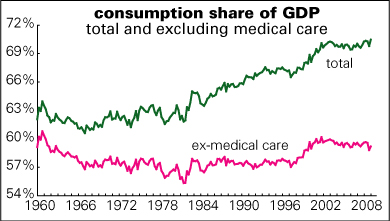
I enjoy seeing a statistic that changes my preconceptions about an issue. Over this decade I've read many articles about the excess spending by American consumers and how people were buying cars, flat-screen TVs, etc...

This article by Doug Henwood shows the share of consumption relative to GDP with and without medical expenses. I guess the UK picture would look completely different given the impact of NHS.


I guess this yet another good reason to improve the health-care system in the US.

Wednesday, January 13, 2010

Poor Haiti!

Poor people in Haiti, who seem to have been hit by every possible man-made and natural disasters know to mankind.


Hope that they can receive as much help as they sorely need and can rebuild/improve their country quickly.

For those of you who would like to help, here is a Google-page with well-known organizations that are accepting donations for the relief effort.

http://www.google.com/relief/haitiearthquake/#utm_campaign=en&utm_source=en-ha-na-us-sk&utm_medium=ha&utm_term=haiti%20support

Tuesday, January 12, 2010

So Long Holiday Feeling!

Wow, it doesn't even feel like I just came back from a very pleasant holiday break in Brazil! This is a gone be a busy couple of weeks!

This Friday there is a deadline (the 2010 FMA meeting in NYC in October), I'm finishing a revision to re-submit a paper to the RFS (fingers crossed for me!) and "own" things to three different sets of co-authors. in very orthogonal projects. Luckily - or not - one of them works right next door to me. so I can always negotiate a small extension...

I guess the alternatives to have to work a lot are much worse. Finding interesting and useful ideas were the most difficult aspect of the PhD (and always a challenge). Hope my (poor) time management skills kick in and everything gets done fast.

Anyway, dinnertime and then back to work!

Friday, January 8, 2010

Freezing Europe - From Space Edition

Most of you know about or having been feeling the effects of the cold snap hitting Europe and the US. The UK has been particularly hit by it and today the BBC showed one of the prettiest pictures I've seen so far:


I really wish that sub-orbital flights were cheap enough such that I could go take a peek of Earth from above. I wouldn't mind getting rich either... This company (based in Barcelona) has a really cool business model. I hope they succeed!

Tuesday, January 5, 2010

Paul Krugman on Crises

For my (few) non-academic readers, every January Econ and Finance academics get together for the AEA/AFA meetings, the most important conference we have. (Off-topic: for anecdotes on how cheap economists are during these meetings, check this WSJ article)

This year they took place in Atlanta, where I heard was freezing relative to the nice weather in San Francisco last year. On top of presenting papers, interviewing job market candidates and going out for dinners with old friends, people also get to attend panels and luncheons with speeches by top people.

I just read Paul Krugman's summary of his Nobel luncheon speech on financial crises. It's a very good piece looking the effects of the current financial crisis relative to previous currency crisis.

Every time I think about currency crises, I think about Mark Twain's quote:  "History does not repeat itself, but it often rhymes."